
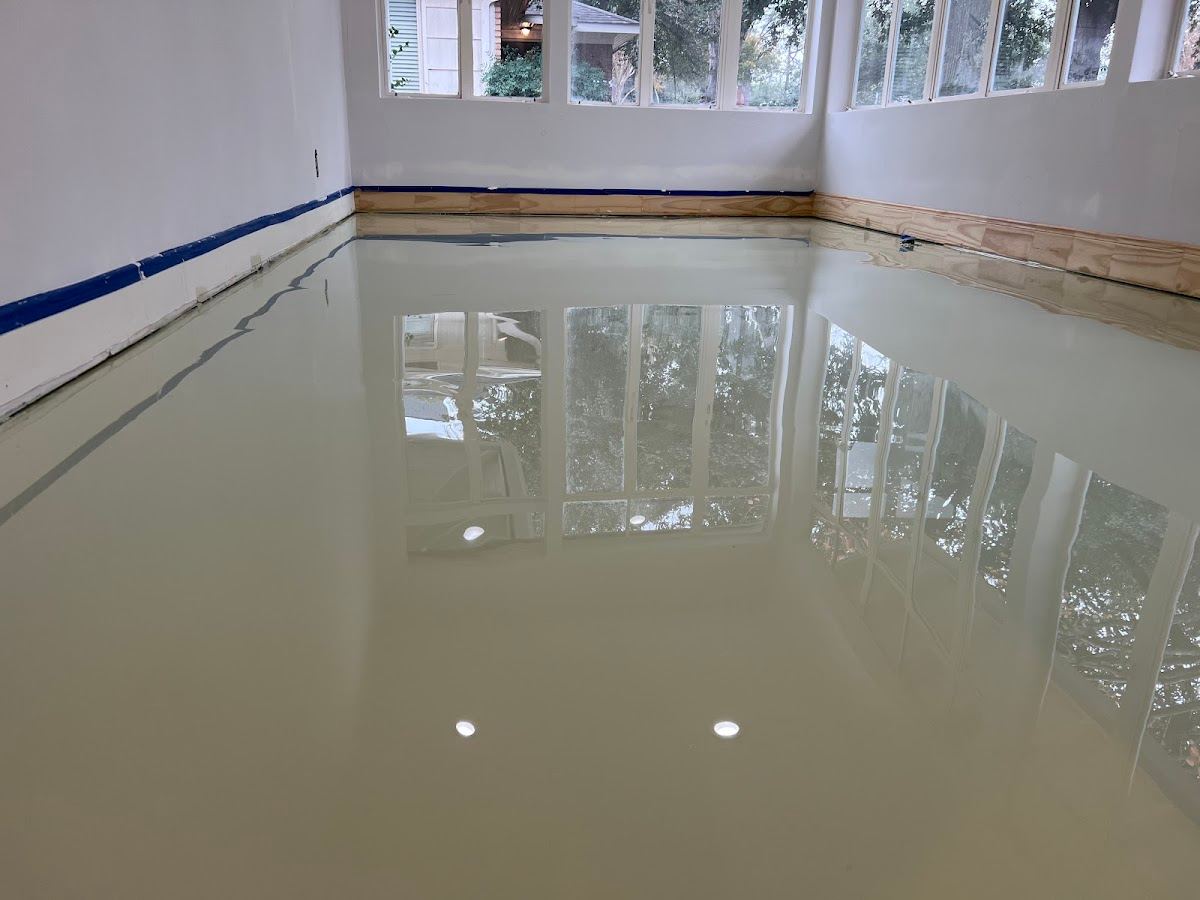
If you are pricing a new floor for a garage, shop, showroom, warehouse, or restaurant, two options dominate the conversation: epoxy flooring and polished concrete. Both turn a plain gray slab into a finished, hardworking surface, and both are built to take real abuse. But they are fundamentally different systems, and neither one is automatically "better."
The right call comes down to how you use the space, the look you want, your budget over the long haul, and the condition of the slab underneath. Here in League City and across the Gulf Coast, our slab-on-grade foundations and year-round humidity add a few wrinkles that most online comparisons skip entirely. Here is the honest, no-hype breakdown from Andrew and the crew.
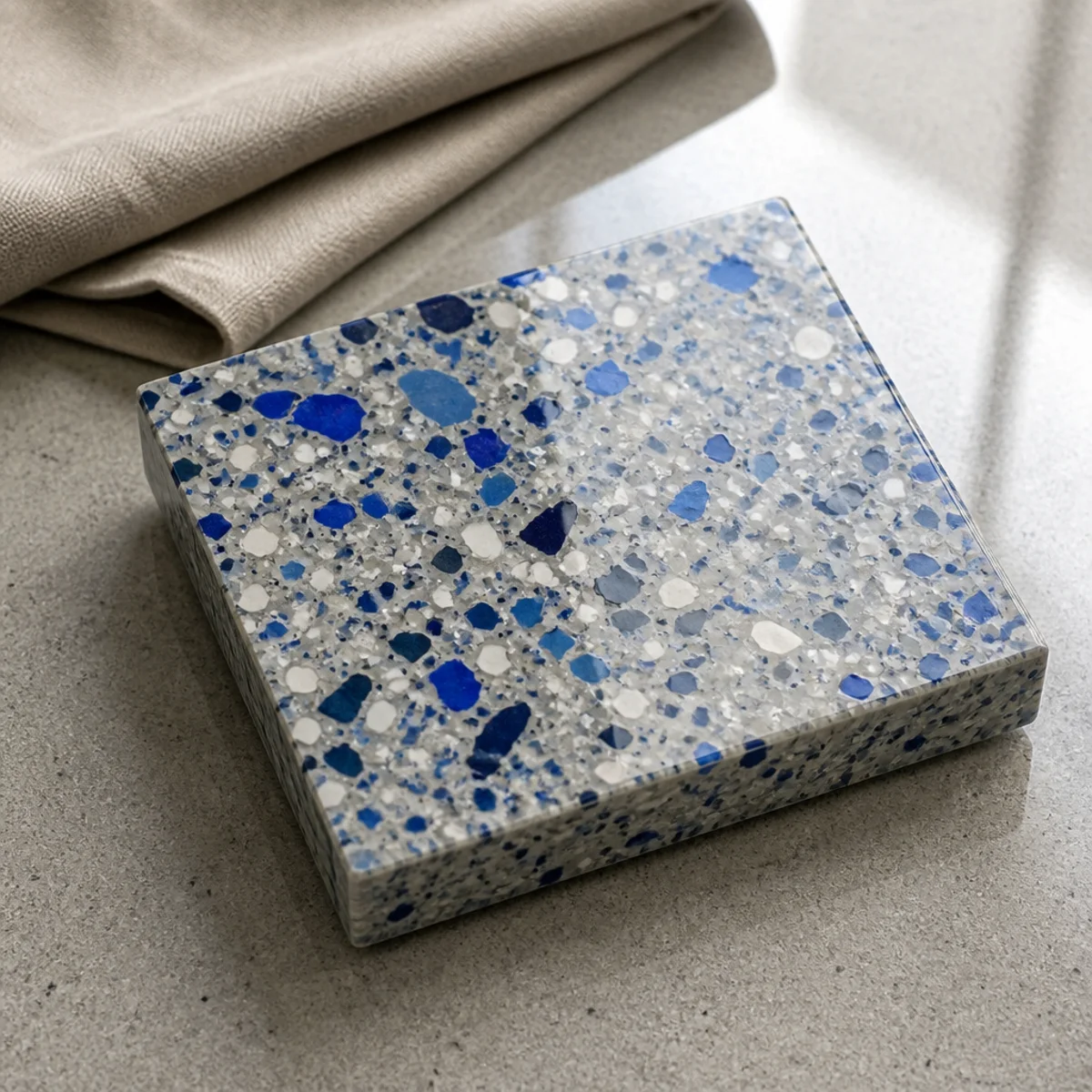
Epoxy vs Polished Concrete: The Quick Answer
There is no universal winner, but the decision is usually clear once you know your priorities.
| Factor | Epoxy Flooring | Polished Concrete |
|---|---|---|
| What it is | A resin coating bonded on top of the slab | The slab itself, mechanically refined |
| Look | Solid colors, flake, metallic, high gloss | Natural concrete, soft matte to high sheen |
| Chemical resistance | Excellent | Limited (porous, needs sealing) |
| Slip control | Adjustable with anti-slip aggregate | Can be slick when wet |
| Can it peel? | Yes, if prep or moisture is wrong | No coating to peel |
| Best for | Garages, kitchens, medical, workshops | Retail, showrooms, warehouses |
In short: if you want decorative variety, chemical resistance, and a custom look, epoxy flooring usually wins. If you want a clean, modern surface with the lowest lifecycle cost on a sound slab and you like the natural concrete aesthetic, polished concrete is hard to beat. The rest of this guide is about the details that actually drive that choice.
What Is Epoxy Flooring?
Epoxy flooring is a two-part resin system mixed and applied over properly prepared concrete. Once cured, it chemically bonds to the slab and forms a hard, seamless, non-porous surface. Most floors people call "epoxy" are really layered systems built from several products.
A typical buildout looks like this:
- Base coat that penetrates and bonds to the prepared concrete
- Decorative layer such as broadcast flake or poured metallic pigment
- Protective topcoat, often a polyaspartic, which adds UV stability, abrasion resistance, and a faster cure
That last layer matters on the Gulf Coast. Polyaspartic topcoats resist the ambering (yellowing) that bargain epoxy shows in sunlight, and they let a crew turn a space around far faster than old-school epoxy. The decorative options are where epoxy really separates itself: flake epoxy floors for a textured, speckled, slip-friendly finish, or metallic epoxy floors that move like marble or flowing water. The catch is that everything depends on prep and slab moisture, which we will come back to.
What Is Polished Concrete?
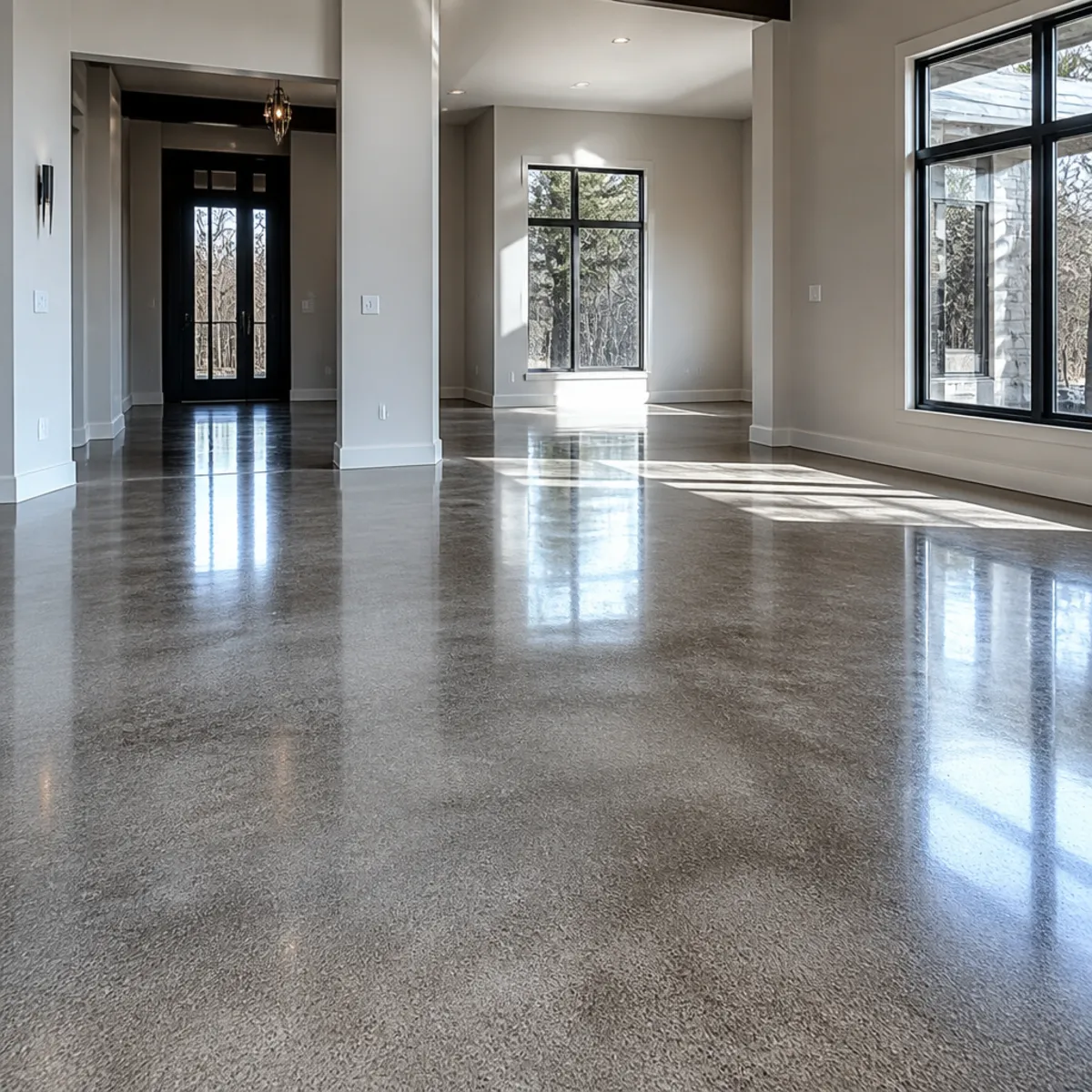
Polished concrete is not a coating at all. It is a mechanical process. Using progressively finer diamond tooling, the crew grinds and refines the existing slab, then applies a chemical densifier that hardens the surface from the inside out. The result is a smooth floor with a sheen you can dial from a soft satin to a near-mirror gloss, depending on how far the polishing goes.
Because the slab itself becomes the finished floor, there is nothing on top to delaminate, chip, or peel. That gives polished concrete an extremely long structural life and the lowest "added material" footprint of any finished floor. The trade-off is that you are working with the concrete you have. Color and design options are limited to dyes and the slab's natural character, and a cracked, spalled, or contaminated slab will limit how good the final result can look. Polished concrete shines in commercial spaces across Texas where that clean, industrial-modern aesthetic is the goal.
Head-to-Head Comparison
Here is where the decision actually gets made, factor by factor.
Appearance and Design
This is the clearest difference. Epoxy is the customizable one: match a brand color, broadcast flake to hide imperfections and add grip, or pour a one-of-a-kind metallic floor. High gloss or satin, light or dark, subtle or bold, you control the result.
Polished concrete is the minimalist's choice. It looks clean, natural, and modern, and it leans into the honest character of the slab. Dyes can add tone, but you will not get flake texture or metallic depth. If your goal is "warm, organic, understated," polished wins. If it is "make a statement" or "match these exact colors," epoxy wins.
Durability and Lifespan
Both are tough, but they fail differently. Polished concrete cannot peel or delaminate because it is the slab, so its structural life runs for decades. Its main vulnerability is staining and etching, since concrete stays slightly porous and needs to be kept sealed and burnished.
A quality epoxy floor adds real chemical and abrasion resistance the bare slab does not have. Its topcoat is what wears over years of traffic, and the good news is that a sound epoxy floor can be re-topcoated to add years rather than fully replaced. Under hot tires, forklifts, and dropped tools, both systems hold up well when installed right, and both fail early when prep is rushed. If you want a deeper look at coating longevity, see how long epoxy flooring lasts.
Cost
We do not post fixed prices because honest numbers depend on your slab, your square footage, and the finish level. But the patterns that drive cost are real and worth understanding:
- Slab condition. Cracks, spalling, oil contamination, and old coatings all add prep before either system can go down.
- Square footage. Larger jobs spread mobilization and setup over more area.
- Finish level. For epoxy, solid color sits at one end, flake in the middle, and poured metallic at the higher end. For polished concrete, a higher sheen and more grinding passes raise the number.
- Moisture mitigation. A slab that tests wet needs treatment before any coating, which adds cost on the epoxy side specifically.
Polished concrete often has the lower lifecycle cost on a sound slab, because you are refining concrete you already paid for rather than adding material. But the cheapest quote is rarely the cheapest floor once you factor in how long it lasts and how many times it has to be redone.
Maintenance
Both are low-maintenance compared to tile, carpet, or VCT. The difference is in what they ask of you over time.
Epoxy resists chemicals and stains, so spills wipe up without etching, a real advantage in shops and kitchens. Polished concrete needs periodic re-burnishing and resealing to keep its sheen and stain resistance, especially in high-traffic retail. Neither is high-effort. If you want the most forgiving surface against harsh chemicals, epoxy has the edge. Our guide on maintaining an epoxy garage floor covers the simple routine in detail.
Slip Resistance and Safety
This matters more than people expect. A high-gloss polished floor can get slick when wet, a concern in entryways, kitchens, and anywhere water gets tracked in. Polishing can be finished at a lower sheen to help, but it is still a smooth concrete surface.
Epoxy has a built-in advantage: anti-slip aggregate can be broadcast into the topcoat to create grip exactly where you need it. For restaurants, commercial kitchens, and wet processing areas, that adjustable traction is often the deciding factor.
Which Holds Up Better in Texas Conditions?
This is where Gulf Coast reality separates a floor that lasts from one that fails, and it is the part generic comparisons ignore.
Slab-on-Grade Moisture
Most of our homes and buildings sit on slab-on-grade foundations. With no basement and a high water table, moisture vapor drives up through the concrete year-round. Polished concrete handles a sound, dry slab beautifully because there is no coating to lift. But epoxy is a coating, and a coating placed over a slab with untreated moisture can blister, bubble, and delaminate. That is not an epoxy flaw; it is a prep-and-testing failure. We run moisture testing and use proper mitigation before we coat, which is exactly why professional surface preparation is non-negotiable down here. Diamond concrete grinding opens the slab to the right profile so the system can bond, and we explain why in our piece on concrete grinding before epoxy.
Heat and UV
In sun-exposed areas like patios, near big windows, or behind roll-up doors, standard epoxy can amber over time. A UV-stable polyaspartic topcoat solves that. Polished concrete, having no coating, has no UV issue at all. So in extreme sun exposure, both polished concrete and a properly topcoated epoxy work well, while a bargain epoxy without UV protection will not.
Best Uses for Each (and When to Use Both)
After all the comparisons, here is the short version of where each one shines.
Epoxy is usually the better call for:
- Garages and home workshops where hot tires and oil are routine
- Restaurant and commercial kitchens that need chemical resistance and anti-slip texture
- Pharmacies, clinics, and medical spaces needing a seamless, sanitary surface
- Auto shops, gyms, hangars, and any space wanting custom color or branding
Polished concrete is usually the better call for:
- Retail stores and showrooms wanting a clean, modern look
- Large warehouses and distribution floors where lifecycle cost rules
- Big open commercial spaces on sound, dry slabs
There is real overlap. A boutique showroom might want a metallic epoxy statement floor, while a high-end garage might prefer the understated polished look. And in many commercial warehouses across Texas, the smartest spec uses both: polished concrete in open storage aisles and epoxy in chemical-handling zones, wash bays, or maintenance areas. You are not locked into one finish for the whole building.
How South Coast Epoxy Helps You Decide
We install both systems, so we have no reason to push you toward one when the other fits better. Andrew and the crew assess your slab condition, run moisture testing, talk through how you actually use the space, and then recommend honestly. Sometimes that means epoxy. Sometimes it means polishing the slab you already own. Sometimes it means fixing cracks and prepping the surface first, no matter which finish you choose.
We work throughout the Gulf Coast, from League City and Clear Lake to Houston, Friendswood, and Webster. Our 57 reviews and 4.9 rating reflect a simple approach: prep it right, recommend the right system, and stand behind the work.
Not sure whether epoxy or polished concrete fits your home or business? Email us at info@southcoastepoxy.com or reach out through our contact page, and Andrew's team will assess your slab and help you choose the floor that actually fits your space, your budget, and the Texas climate. The honest conversation is free, and it is a lot cheaper than redoing the wrong floor.
Frequently Asked Questions
Is polished concrete cheaper than epoxy?
Often yes over its lifetime on a sound slab, since you are refining concrete you already own. But the final cost depends on slab condition, square footage, and how high a finish you want.
Which lasts longer, epoxy or polished concrete?
Polished concrete cannot peel because it is the slab itself, so it has a very long structural life. A professionally installed epoxy floor is also very durable and chemical-resistant, and its topcoat can be refreshed over time.
Can you put epoxy over polished concrete?
Not directly. Polished concrete is too dense and sealed for a coating to bond well. The surface has to be ground and re-profiled first, which we evaluate before quoting any coating.
Which is better for a Texas restaurant kitchen?
Epoxy with anti-slip aggregate is usually the better fit for kitchens because of its chemical resistance, seamless cleanability, and slip safety on wet floors.
About South Coast Epoxy
South Coast Epoxy is a locally owned epoxy, polished concrete, and flooring contractor based in League City, TX, serving homeowners and businesses across the Houston Bay Area. Owner Andrew and his crew specialize in durable, great-looking floors built for the Texas Gulf Coast. Get a free quote →