
Flooring Service
Garage Floor Coatings in Houston & League City, TX
Epoxy and polyaspartic garage coatings matched to how you use the space.
Not every garage needs the same coating — and that's the point of this service. South Coast Epoxy installs both epoxy and polyaspartic garage floor coatings across Houston and League City, then helps you pick based on cure time, traffic and budget. Andrew is upfront about trade-offs, like several customers have noted, and won't push the priciest product if a simpler system fits.
How it works
This page focuses on the coating chemistry choice. Epoxy offers a thick, economical, high-build base with great adhesion. Polyaspartic cures fast (often a one-day install), resists UV yellowing, and holds up better to hot tires — but costs more. Many of our garages combine them: an epoxy base for build plus a polyaspartic topcoat for speed and durability, with flake added for texture and looks.
Benefits
- Choice of epoxy, polyaspartic, or hybrid systems
- Fast-cure polyaspartic for one-day-style installs
- Hot-tire, oil and chemical resistance
- UV-stable options that won't yellow near the door
- Anti-slip flake texture available
- Honest guidance on cost vs. performance
Best Used For
- Daily-driver and multi-car garages
- Workshops and home gyms
- New-build garages before move-in
- Garages needing a fast turnaround
- Sun-exposed garages with open doors
- Resale prep and curb-appeal upgrades
Get a free garage floor coatings quote
A bare concrete garage slab in the Houston Bay Area takes a beating: hot tires in July, road salt and oil, humidity rolling in off the Gulf, and a slab that quietly moves with the clay underneath it. The right garage floor coating turns that slab into a sealed, easy-to-clean, hot-tire-resistant surface that looks good for years. South Coast Epoxy installs both epoxy and polyaspartic garage floor coatings across Houston and League City, and owner Andrew matches the system to how you actually use the space — not to whatever costs the most.
What a Garage Floor Coating Actually Is
A garage floor coating is a resin system bonded directly to your concrete slab, not a mat, tile, or paint you roll on from a hardware-store kit. A real coating is built in layers: a mechanically prepped slab, a pigmented base coat that grips the concrete, an optional broadcast of decorative flake for texture and looks, and a clear topcoat that takes the abuse. Done correctly, those layers fuse into one continuous membrane a few mils to over 100 mils thick depending on the system.
That bond is everything. The reason cheap DIY epoxy peels in a Texas summer is almost always prep — a slick, sealed, or contaminated slab that the resin never truly anchored to. We diamond-grind every floor to open the concrete to the right profile (typically a CSP 2-3) so the coating mechanically keys into the surface. The chemistry matters, but prep is what makes a garage floor coating last. If you want the deeper picture on how the whole system compares to bare or polished slabs, our guide on epoxy flooring vs polished concrete breaks it down.
The Real Benefits — In Plain Terms
A properly installed coating does several things at once. It seals the concrete so oil, brake fluid, antifreeze, and dropped solvents wipe up instead of soaking in and staining. It resists hot-tire pickup — the failure mode where a parked tire literally lifts a weak coating off the slab as it cools. It brightens the whole garage, because a light flake or metallic finish reflects light and makes a dim two-car bay feel usable. And it shrugs off the dusting that bare concrete constantly sheds onto your tools, totes, and car.
It also makes the space genuinely easier to live with. Spills mop up, the floor doesn't trap moisture and mildew, and a flake or quartz texture gives you slip resistance when you track in rain. For a lot of our customers, it's the difference between a garage that's a glorified storage closet and one they actually use as a workshop, gym, or clean second entry into the house.
Texas & Gulf-Coast Considerations Most Companies Skip
This is where a local crew earns its keep. Our slabs are slab-on-grade over expansive clay, which means they move seasonally and develop cracks and joints that a coating has to be detailed around, not just buried under. We diamond-grind, then fill cracks and spalls with the right repair products before any color goes down, so movement doesn't telegraph through as an ugly line a month later. There's more on why this step is non-negotiable in our piece on concrete grinding before epoxy.
The bigger Gulf-Coast issue is moisture. Many League City and Houston slabs sit on grade with no vapor barrier, and moisture vapor drives upward through the concrete. If that vapor pressure is high enough, it will push a coating off the slab — blisters, bubbles, delamination. So on slabs where it's warranted, we moisture-test before quoting a system, and we choose chemistry and primers that tolerate the conditions instead of pretending they don't exist.
Heat and UV are the third factor. Garages with the door open all afternoon cook the area near the threshold, and standard epoxy can amber (yellow) and soften under prolonged sun and high slab temperatures. That's a big reason we lean on UV-stable polyaspartic topcoats for sun-exposed bays and any flooring that runs out toward the driveway or a patio.
Your System & Finish Options
Most of the decision comes down to the resin and the look. Here's how the common choices stack up for a Texas garage:
| System | Strengths | Best for |
|---|---|---|
| Epoxy base | Thick, high-build, economical, excellent adhesion | Budget-conscious builds, a strong foundation layer |
| Polyaspartic | Fast cure, UV-stable (won't yellow), great hot-tire resistance | Sun-exposed bays, fast turnarounds, premium durability |
| Epoxy + polyaspartic hybrid | Epoxy build plus a tough, UV-stable topcoat | The most popular all-around garage floor |
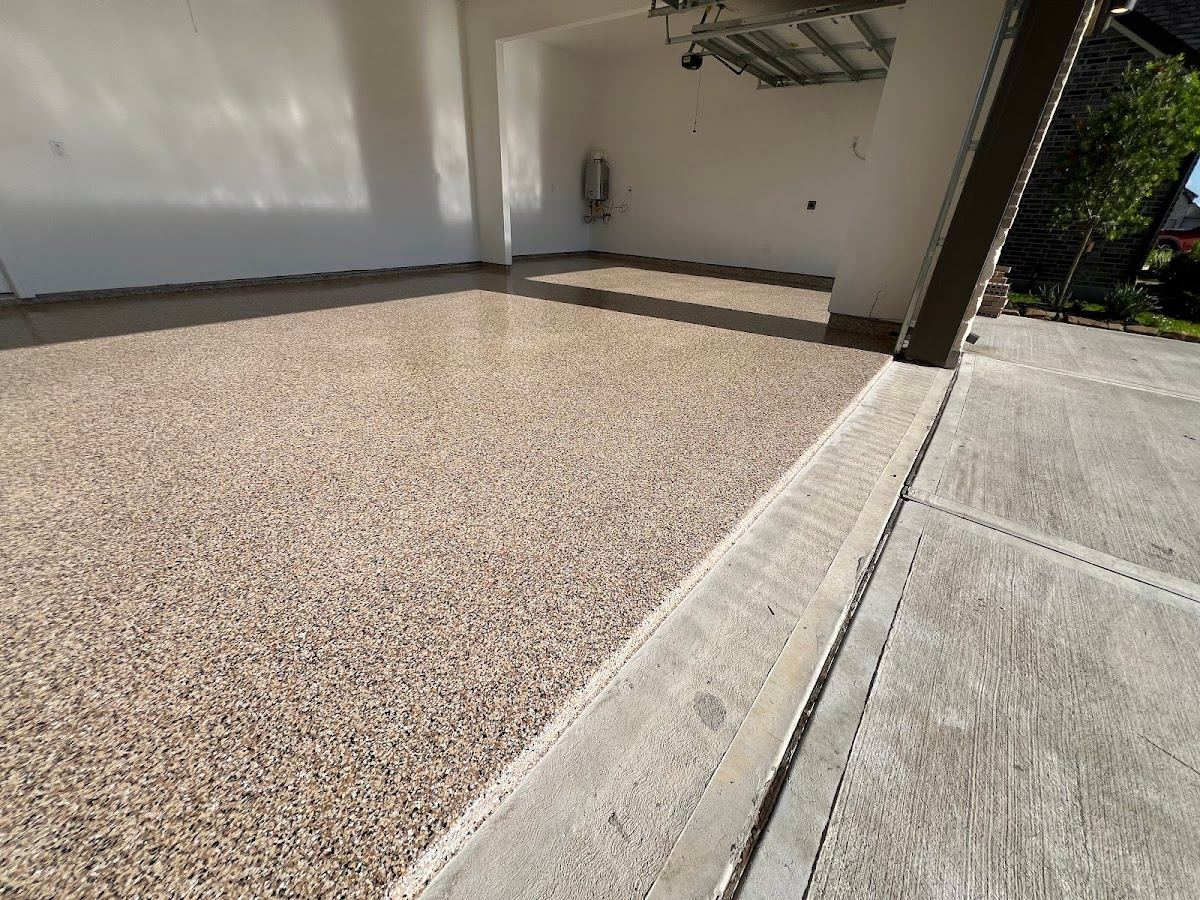
On top of the resin, you choose the finish. Full-flake broadcast — chips troweled to refusal and topcoated — is the classic garage look: hides imperfections, adds slip resistance, and comes in dozens of color blends. A lighter partial flake or solid color keeps it clean and simple. For something more dramatic, metallic epoxy floors create a marbled, three-dimensional finish, and quartz epoxy floors add a heavier, more aggressive texture for working garages. Not sure which way to go? Our flake epoxy floors benefits post is a good starting point.
Who This Is Best For
This service is built around real garages and the spaces attached to them. We coat:
- Daily-driver and multi-car garages — the bread-and-butter hot-tire-and-oil resistant floor.
- Home workshops and gyms — durable, easy-to-sweep, and forgiving when you drop a wrench or a dumbbell.
- New-build garages — coated before move-in, while the slab is clean and empty (note: fresh concrete needs adequate cure time first).
- Sun-exposed garages with open doors — where UV-stable polyaspartic keeps the color true.
- Resale and curb-appeal prep — a finished garage floor is a cheap, high-impact upgrade buyers notice.
If your needs run bigger — a shop, fleet bay, or commercial space — that's a different conversation, and we handle it under commercial epoxy flooring and warehouse flooring. For a residential garage, this page is the right home.
How the Installation Goes
A typical garage runs as a clean, repeatable process:
- System consult. We talk through epoxy vs. polyaspartic vs. hybrid based on your use, timeline, and budget — and moisture-test the slab where it matters.
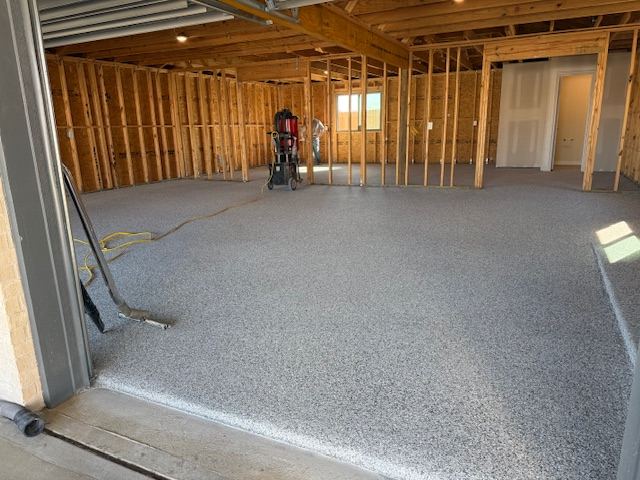
- Diamond grind & repair. We mechanically profile the concrete with diamond tooling, then fill cracks, spalls, and pits. This is the surface preparation step that makes or breaks longevity.
- Base coat. A pigmented epoxy or polyaspartic base is applied to the prepped, opened slab.
- Flake broadcast (optional). Chips are broadcast into the wet base for texture and color, then the excess is scraped and the floor is sanded smooth.
- Clear topcoat. A polyaspartic or epoxy clear coat locks everything in and provides the wear surface.
- Cure & return. We give you specific walk-on and drive-on times before you put weight back on it.
Because polyaspartic cures fast, many garages can be a one-day-style install — prepped and coated in a day, with drive-on time shortly after, depending on size and conditions.
Honest Cost Factors
We don't post a single price because no two garages are the same, and a number on a website usually hides the prep that actually matters. What drives your quote:
- Square footage — a single-car bay versus a three-car-plus garage.
- Slab condition & prep — cracks, spalling, oil saturation, old failing coatings, or sealers all add labor.
- System choice — polyaspartic and hybrids cost more than a basic epoxy, and full-flake adds material.
- Repairs & moisture mitigation — significant crack repair or a slab that needs a moisture-tolerant build.
Andrew's approach is to walk the floor, tell you what it genuinely needs, and recommend the system that fits — not auto-upsell the top tier. If a simpler build does the job, that's what you'll hear. We get into the trade-offs more in our garage floor coatings Houston guide.
Coating vs. the Alternatives
A few honest comparisons. Versus bare or sealed concrete, a coating wins on stain resistance, cleanability, and dusting — sealed concrete still soaks up oil over time. Versus polished concrete, polishing is beautiful and ultra-durable but it's a finish on the existing slab, so its color and character are whatever your concrete already is; a coating lets you choose color, flake, and texture (more on polished concrete if that's your lean). Versus roll-on DIY epoxy kits, the gap is prep and chemistry — a ground slab with a commercial-grade hybrid system simply lasts where a painted-on kit peels under hot tires within a season.
Maintenance & Longevity
These floors are easy to keep. Sweep or dust-mop regularly, damp-mop with a mild cleaner, and wipe spills reasonably promptly — even though the surface resists staining, you don't want chemicals sitting forever. Skip harsh degreasers and avoid dragging sharp steel edges across it. Use a soft pad if you scrub.
How long it lasts comes down to the system and, again, the prep underneath it. A properly installed, UV-stable garage coating on a well-ground slab holds up for many years of daily driving and shop use. We hand off simple care guidance at the final walkthrough so you know exactly what your specific floor wants. For a deeper routine, see how to maintain an epoxy garage floor and how long epoxy flooring lasts.
Why Choose South Coast Epoxy
We're locally owned and based in League City, and we coat garages throughout the Houston Bay Area — including Pearland, Clear Lake, Friendswood, and out to Galveston. Because we work these slabs every week, we know how Gulf-Coast heat, humidity, and slab-on-grade movement behave, and we build for them instead of being surprised by them.
What you get with Andrew and his crew: proper diamond grinding and crack repair, moisture testing where it's warranted, honest system recommendations, clear communication, fair pricing, clean prep, and a final walkthrough so you know how to care for the floor. No pushy upsell, no mystery — just a garage floor that's done right the first time.
Get a Free Quote
Ready to turn your bare slab into a sealed, hot-tire-resistant, great-looking garage floor? Email info@southcoastepoxy.com with your garage size, a couple of photos of the slab, and how you use the space, and we'll get you an honest recommendation and a free quote. Start a conversation on our contact page — Andrew will tell you straight which system actually fits your garage.
Recent Garage Floor Coatings Projects
Our Process
System consult
Epoxy vs. polyaspartic vs. hybrid based on your needs.
Grind & repair
Diamond-grind, fill cracks and spalls.
Base coat
Apply a pigmented epoxy or polyaspartic base.
Flake (optional)
Broadcast chips for texture and looks.
Topcoat
Polyaspartic or epoxy clear coat.
Cure & return
Provide walk-on and drive-on times.
Garage Floor Coatings FAQs
Epoxy or polyaspartic — which is better?
Neither is "best" for everyone: polyaspartic cures faster and resists UV and hot tires; epoxy is a great-value high-build base. We often combine them, and Andrew recommends based on your use and budget.
Can it be done in a day?
Polyaspartic systems can enable fast, often one-day installs depending on size and conditions; we'll confirm for your garage.
Will it yellow in the sun?
Polyaspartic and UV-stable topcoats resist yellowing — important for garages with open doors.
Does it resist hot tires and oil?
Yes — these systems are chosen specifically to resist hot-tire pickup, oil and chemicals.
How do I maintain it?
Sweep and damp-mop; wipe spills promptly. We provide simple care guidance at handover.
Ready to Upgrade Your Floors?
Whether you need a garage epoxy floor, polished concrete, a commercial coating system, a restaurant floor, a warehouse floor, or a custom countertop finish, South Coast Epoxy will help you choose the right surface system for your space.
Prefer email? Reach us at info@southcoastepoxy.com